
Montessori Rolling Ball Development Game – A Perfect Educational Toy for Babies
As parents, we’re constantly on the lookout for toys that do more than just entertain. We want toys that nurture growth, spark curiosity, and provide meaningful playtime experiences. One such toy that has taken the parenting world by storm is the Montessori Rolling Ball Development Game. Designed with the principles of Montessori education in mind, this toy is more than just fun—it’s a foundation for lifelong learning.
Unlike flashy electronic toys, Montessori-inspired toys are intentionally simple, giving children the chance to engage deeply, problem-solve, and develop at their own pace. The rolling ball game perfectly embodies these qualities, offering babies aged 1, 2, and 3 years a chance to explore cause and effect, improve motor skills, and build confidence—all while playing.
Let’s dive deeper into what makes this toy special, how it benefits your child’s growth, and why Montessori toys like the rolling ball game are becoming a must-have in modern households.
Educational Toy for Babies
Introduction to Montessori Toys
What Makes Montessori Toys Unique?
Montessori toys aren’t like traditional toys you find stacked in every store aisle. They’re carefully designed with simplicity, purpose, and function in mind. Unlike toys with blinking lights and loud sounds that overstimulate children, Montessori toys are meant to engage a child’s natural curiosity without overwhelming them.
These toys follow Dr. Maria Montessori’s philosophy that children learn best through hands-on exploration. For example, a Montessori ball drop or rolling ball game allows a child to experiment, make mistakes, and try again—all of which are crucial steps in learning.
Another thing that sets Montessori toys apart is that they’re usually made of natural materials like wood. The tactile feel of wood connects children to the real world, which is a central principle of Montessori education. Babies can hold, roll, and stack objects while getting sensory feedback that plastic toys often fail to provide.
In short, Montessori toys are not about passive entertainment but about active engagement. They grow with the child, providing different learning opportunities at different stages of development.
Why Montessori Principles Matter in Early Childhood
The early years of a child’s life are incredibly important. In fact, experts say that 90% of brain development happens before the age of five. Montessori principles recognize this and focus on giving children tools that help them learn naturally.
By using toys like the Montessori Rolling Ball Development Game, babies aren’t just playing—they’re practicing focus, patience, and problem-solving. Instead of teaching children what to think, Montessori toys help them discover how to think.
Imagine a baby watching a ball roll down a track. To us, it might look simple, but to the child, it’s an experiment. They’re observing gravity, motion, and sequence—all fundamental concepts in science and logic. That’s the beauty of Montessori toys: they turn everyday play into meaningful learning.
Buy Here

Understanding the Montessori Rolling Ball Development Game
What Is the Rolling Ball Development Game?
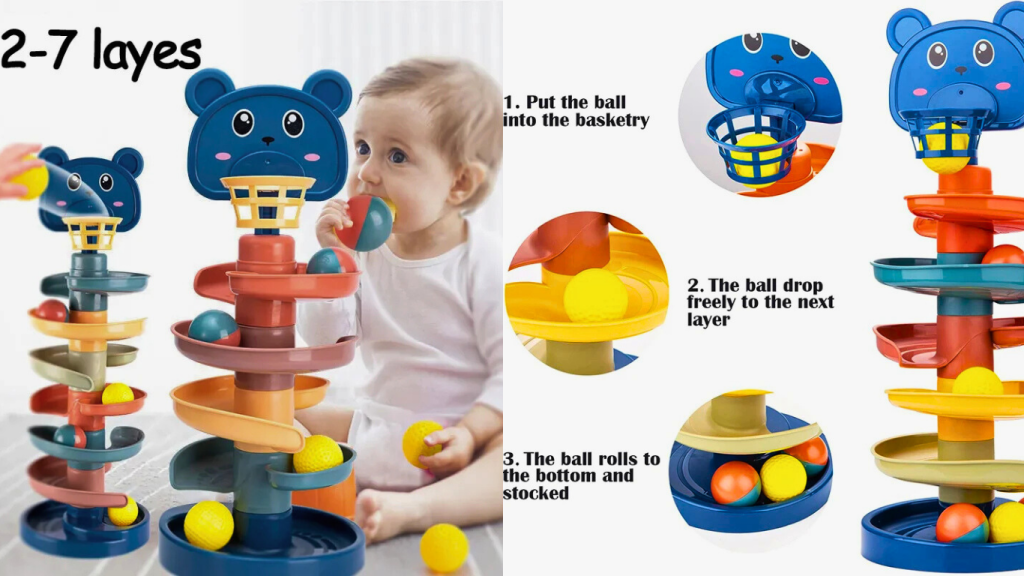
The Montessori Rolling Ball Development Game is an educational toy designed to engage young children in active play. At its core, it’s a simple structure where a baby places a ball at the top, and the ball rolls down a track, often hitting different levels or passing through colorful openings.
This toy isn’t just about watching a ball roll—it’s about helping babies understand cause and effect. When they drop the ball, something happens. That connection builds critical thinking, coordination, and an eagerness to experiment further.
It also serves as a stepping stone for toddlers to practice hand-eye coordination. Grasping the ball, placing it correctly, and following its path develops motor skills in a fun, playful way. Plus, the excitement of watching the ball complete its journey never seems to fade—toddlers will repeat the activity countless times, which strengthens learning through repetition.
Features of Montessori Rolling Ball Toy
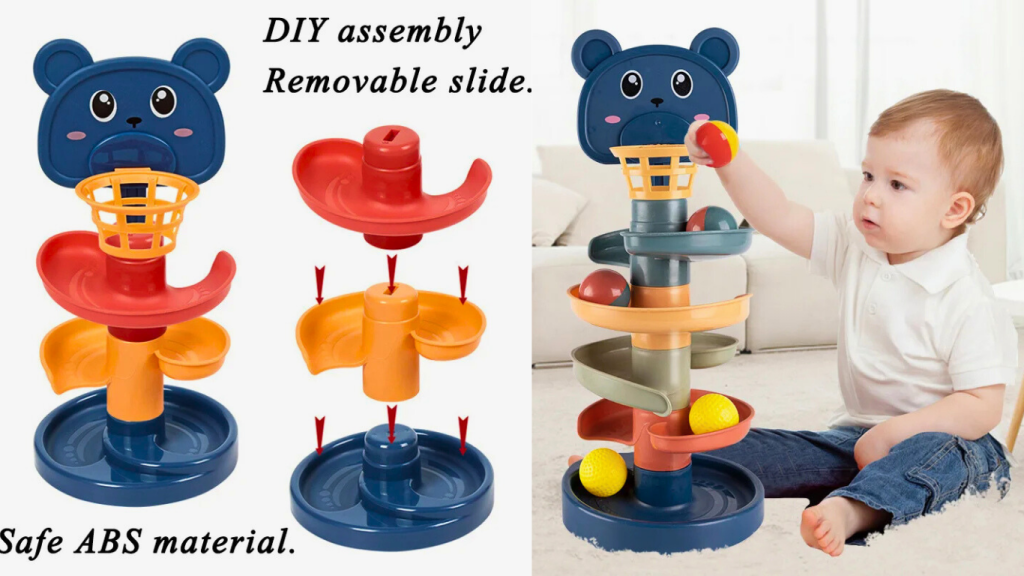
The features of the Montessori rolling ball toy are specifically designed for babies and toddlers:
- Baby-safe materials – Made from smooth, non-toxic wood or BPA-free plastic.
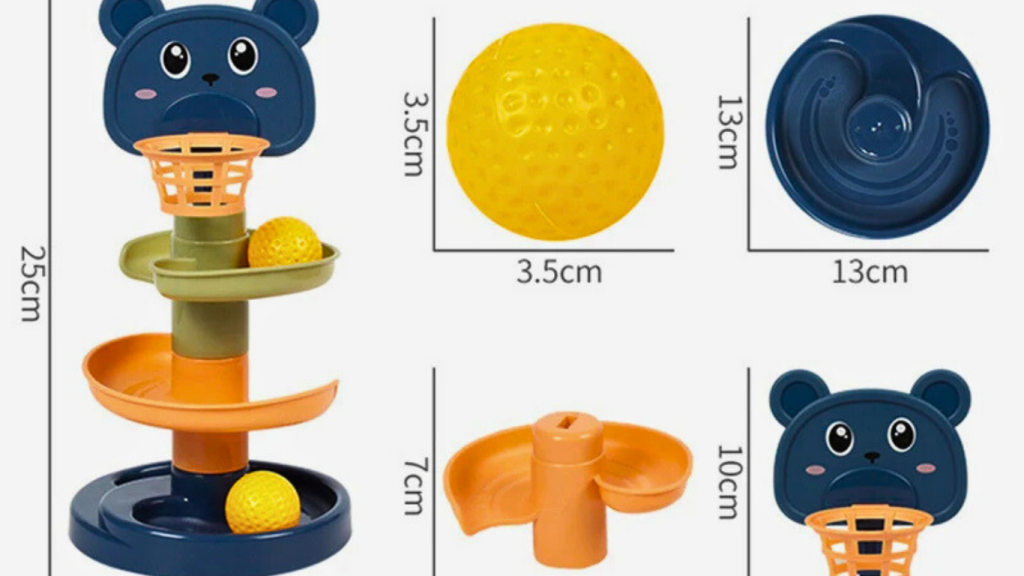
- Easy-to-hold design – Balls are large enough to prevent choking hazards and fit perfectly in little hands.
- Bright colors – Engages visual development without overstimulating.
- Stackable structures – Some variations combine stacking and rolling play, encouraging creativity.
- Durable build – Designed to withstand rough play and last for years.
What makes this toy even more special is its adaptability. For a 1-year-old, it’s about dropping the ball and watching. For a 2-year-old, it’s about mastering hand control. For a 3-year-old, it’s about creating challenges, experimenting with speed, or even building stacking structures around it.
Click Here
Educational Benefits of Montessori Rolling Ball Toys
Enhancing Hand-Eye Coordination
Hand-eye coordination is one of the most important developmental skills for young children. It’s the ability to use the eyes to guide hand movements—a skill needed for writing, drawing, eating, and almost everything else.
When babies play with the rolling ball game, they practice picking up a ball, aligning it with the opening, and releasing it. Each step requires precise hand-eye coordination. The more they repeat the process, the stronger their skills become.
Even the act of following the ball with their eyes as it rolls down is beneficial. It trains their visual tracking abilities, which later supports reading skills. So, while it may look like simple fun, your baby is actually building crucial lifelong skills.
Improving Motor Skills in Babies
Fine motor skills (small muscle movements) and gross motor skills (large body movements) are both exercised during rolling ball play. Babies practice grasping and releasing the ball, strengthening finger muscles that are later needed for holding crayons, scissors, or pencils.
Toddlers also squat, stand, and move around as they play, which develops balance and core strength. It’s a complete workout hidden inside a playful game!
Encouraging Problem-Solving and Patience
At first, babies may miss the hole or struggle to place the ball correctly. But Montessori toys encourage trial and error, giving children the patience to try again until they succeed. This builds resilience and problem-solving skills.
Every small victory—like getting the ball into the right spot—boosts confidence. Over time, these little wins translate into a strong sense of achievement and determination.
Age Suitability – Why It’s Perfect for 1, 2, and 3-Year-Olds
Developmental Milestones at Age 1
At one year old, babies are just beginning to explore their world with more independence. They’re learning to stand, crawl faster, and maybe even take their first steps. The rolling ball toy is perfect for this stage because it’s simple yet engaging.
At this age, babies enjoy the repetition of dropping the ball and watching it roll. It helps them understand that their actions create outcomes. This is the start of building cause-and-effect awareness, a key cognitive milestone.
Growth and Learning at Age 2
By age two, toddlers are developing better hand control and stronger motor skills. They’re also beginning to problem-solve more intentionally. With the rolling ball game, they not only drop the ball but may also try to guide it, experiment with speed, or even add imaginative play (pretending the ball is a car or animal).
This stage is also when toddlers start using language more effectively. Playing alongside parents or other children with the toy encourages communication, social interaction, and sharing.
Expanding Skills at Age 3
Three-year-olds are full of curiosity and imagination. They’re refining coordination, experimenting with logic, and developing more patience. At this stage, the Montessori rolling ball game becomes more than just a toy—it becomes a tool for creativity.
Some versions of the toy include stacking towers, ramps, or different pathways. A 3-year-old may start building more complex structures and testing different outcomes. This kind of play fosters STEM learning skills in an age-appropriate way, setting the stage for early problem-solving in math and science.